

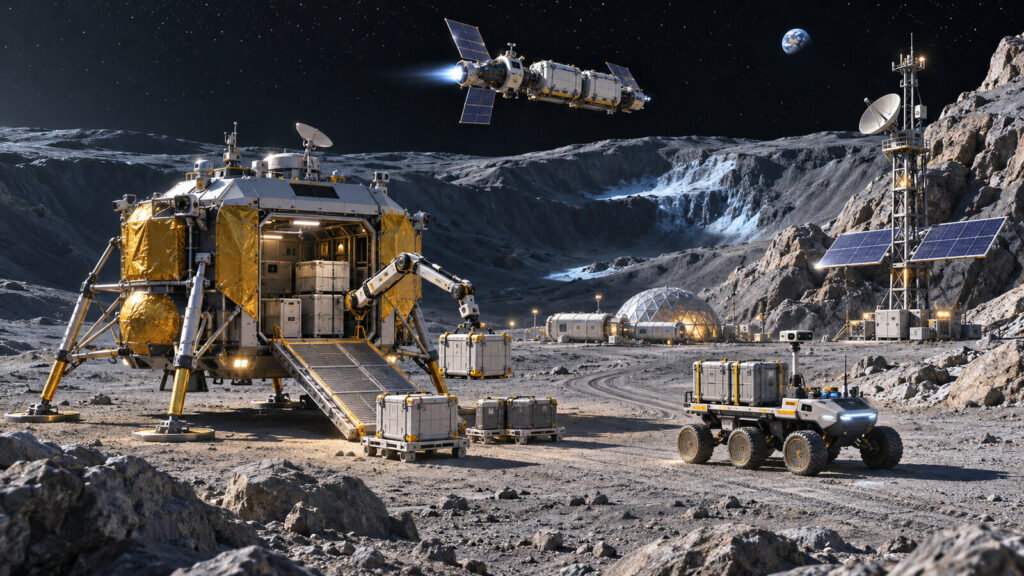
NASA’s November 7 Moon Base announcements add definition to the market for delivering and operating infrastructure beyond Earth. The agency selected eight companies to compete for future surface-delivery task orders under its new Commercial Lunar Payload Services framework and announced additional lunar transportation and technology efforts.
The CLPS 2 indefinite-delivery/indefinite-quantity framework has a combined ceiling of $10 billion over ten years. That is a maximum contractual capacity, not money already obligated to individual contractors. NASA also announced a $94 million base award to Blue Origin, with a $140 million performance-dependent option, to deliver the nuclear-powered PROMISE lunar rover.
The announced architecture spans landers, orbital-transfer vehicles, surface mobility, autonomous drones, communications, navigation, power, and resource assessment. Its value to emerging suppliers lies in recurring subsystem requirements and interfaces across programs, rather than in a single one-off exploration mission.
Space startups and university teams should investigate which prime contractors will need modular payloads, materials and manufacturing processes, autonomy, sensing, logistics, and mission-assurance capabilities. Procurement ceilings signal addressable capacity; actual revenues depend on task orders and delivered services.
Gravonomy takeaway
The lunar economy will mature through integrated transportation and operating infrastructure. Identifying credible buyers, interfaces, and repeatable logistics needs is essential for turning promising space technologies into commercial suppliers.