

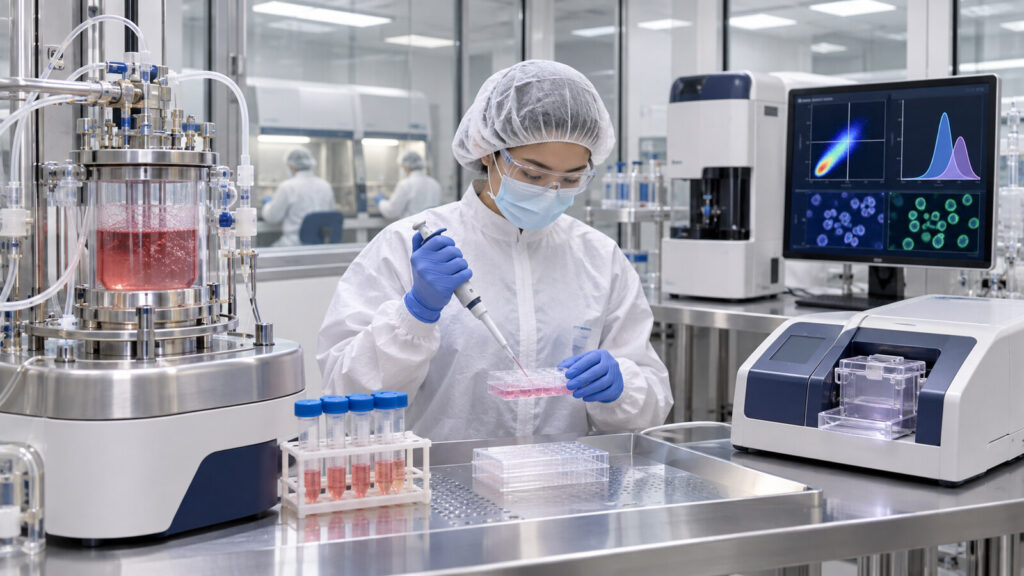
A treatment may begin with a clever gene-editing experiment, but it cannot advance to patients until researchers can manufacture a consistent, clinically suitable product. A newly reported UCLA project illustrates the size of that transition.
On November 4, UCLA researchers described a process to directly correct the mutation responsible for sickle cell disease in a patient’s own blood-forming stem cells. The preclinical team completed seven manufacturing runs, including four at full clinical scale. All full-scale runs met established quality requirements for purity, viability, and editing performance. UCLA has used the process to manufacture products for two participants in an ongoing Phase 1 trial.
This differs from already-approved strategies that add an anti-sickling gene or stimulate fetal hemoglobin: the experimental approach aims to repair the mutation itself using CRISPR-Cas9 and a nonviral repair template. Neither long-term clinical benefit nor safety in treated patients has been established by these manufacturing results.
For university commercialization teams, the relevant market signal is the growing importance of scale-up, process validation, analytical testing, intellectual-property strategy, and clinical manufacturing partnerships. These are areas where company formation, STTR teaming, and specialized technical service providers can move research toward an investable program.
Gravonomy takeaway
A promising cell or gene therapy becomes a viable commercialization prospect only when its manufacturing, quality, regulatory, and clinical pathways are credible. Research institutions should assess these capabilities early, especially when planning licensing, translational grants, and small-business partnerships.